I’ve been away from writing for a bit for personal reasons and I’ve missed talking much about many events in the RISC-V world this year. Here’s a jumble of thoughts from October of 2021.
Low Points: BeagleV Starlight canceled, Nezha/D1 launch issues
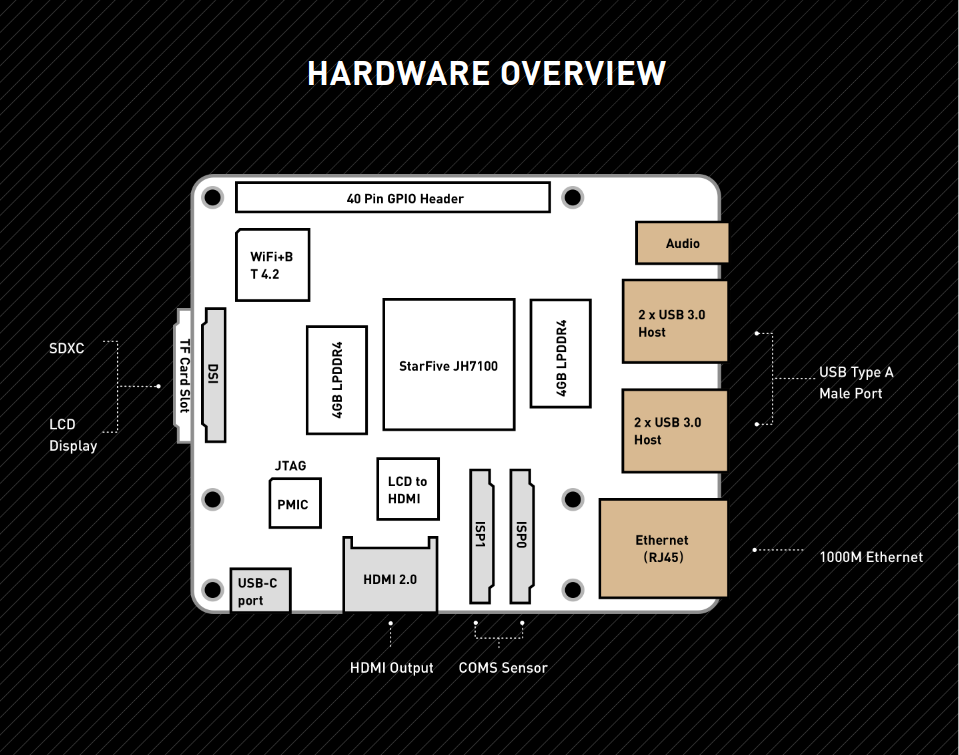
I was lucky to have tinkered with the prerelease BeagleV board (codenamed Starlight) that featured the StarFive
JH-7100 SoC. It was well documented, had an amazing technical group of active participants from both corporate and hobbyist backgrounds, all working together on merit, and good tooling. Antmicro’s ‘Renode‘ emulator made developing on these parts a breeze.
Unfortunately for the business, BeagleV/Starlight and StarFive were unable to reach a production agreement and BeagleV Starlight project was cancelled. I did some software and hardware work that went into the proverbial chipper, but I managed to learn and refine some skills along the way. I remain hopeful that the low-volume (Two core) JH-7100 and later (Quad core, embedded GPU, PCIe) JH-7110 will be delivered at a similar price point by the likes of Antmicro or Radxa, which has already missed their ship date. It’s all resulted in some thrash, but it’s possible that all the players (Beagle, Antmicro, Radxa, Starfive) dust off and ship RISC-V boards.
I have possession of a Nezha developer board. This is the official development board made by Allwinner as a vehicle for their D1 chip. By contrast to StarFive, documentation on this device and board is poor. The maker of the chip and the board, Allwinner,
having a pretty poor record playing nicely with open source developers with license violations being common. When it was at a price point similar to BeagleV, it seemed an underdog as a single core device, but it did have the claim to fame of being the first shipping device of supporting the RISC-V Vector extension. I’ve been a member of a few different discord/slack/telegram groups for this device and they’ve all been dominated by people stuck at the starting line: just finding a maintained distro that doesn’t require a login in Chinese and a phone number in China is a common challenge.
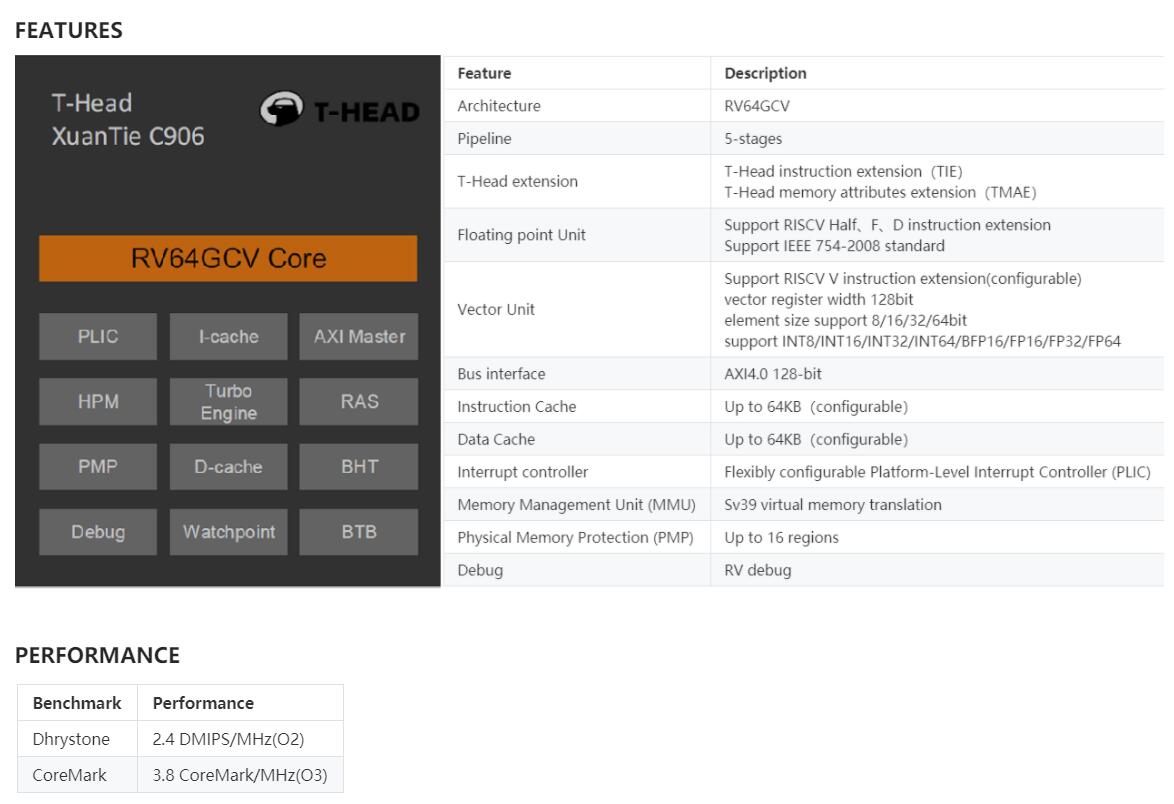
Unfortunately for many developers, D1 supported only 0.7.1 of Vector, which has source and binary incompatibilities with the final 1.0 version of that extension which is currently (October 2021) in final stages of public review. This part also really requires Allwinner’s own use of GCC/Binutils to use these extensions well. Interestingly, the RISC-V part of this SoC comes from Alibaba’s XuanTie C906 line, which was itself recently open-sourced, though there have been serious issues trying to land Alibaba’s incompatible work in upstream projects like GCC and QEMU.
I’d love to be able to comment more on the actual development board, but can’t as it appears my board is apparently totally DOA. I hope to be able to write more about it soon.
This board gets the (somewhat deserved) criticism of being overpriced when compared to high-volume devices like Pi and the (awkward) criticism of having a single 1.0Ghz core and relying on an old version of the Vector specification. As the final version still doesn’t exist and fab times just plain take a while to get from Verilog to real silicon, we can be only so mad at the first chip to support even a pre-release V spec. We can be more upset that the chip requires violating the RISC-V specification on reserved bits in the paging machinery. All this does lead to an up-looking highlight to finish up this catch-up.
On the Horizon: Allwinner D1s/F133
This week, there’s been interest in a new revision of the D1. The Allwinner D1s (sometimes called the “F133” for reasons I haven’t yet grasped) is a cost-optimized version of the original D1. Where the D1 really seemed to ship only with their own development board, Nezha, the D1s seems to come out of the gate ready for the likes of SeedStudio and Mango Pi’s ~$10USD RISC-V board or in low quantity to put on your own open-source boards, like Xassette.
It’s a slightly confusing product, but some of that may just be translation/documentation issues. It’s cost-reduced, and that filters through to the boards we’ve seen so far. There’s 64MB of RAM on board, but it’s sold as “Linux ready”. The removal of HDMI signaling means no monitor and 64MB will require a very stripped down system. Cramming Linux into the 8MB on a K210 was (barely) possible, so this must be possible, even if cramped. Still, for a single-purpose or educational environment, that’s probably OK. The Allwinner F133 overview avoids any comparison to D1, refers to itself as “video decoding platform”, and even avoids use of the phrase “RISC-V” completely.
It’s interesting that one of the most controversial RISC-V chips of 2021 managed to ship a second revision this year while we have so many that have just seemingly collapsed under their own weight or never found their legs beyond original announcements. (Blink twice if you’re alive, PicoRio!)
As we approach the end of the year, we’ve had quite some changes in the RISC-V ecosystem. It’s likely that the product families that have most met or exceeded my expectations are the BL602/706 family and Espressif’s menagerie of ESP32-C3 and ESP32-C6.
What have been your biggest disappointments or surprises in RISC-Ville?